 Pretectal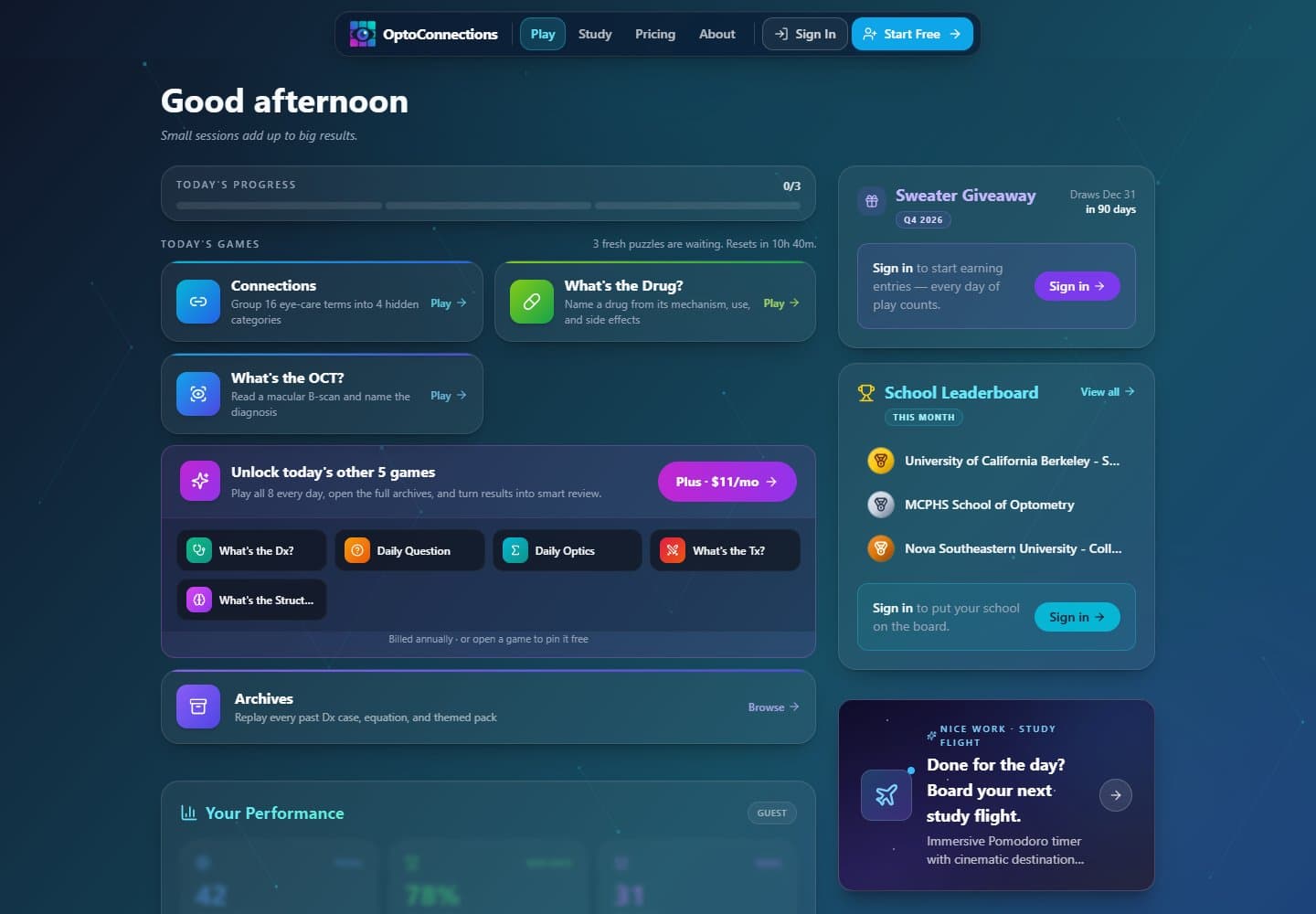
The problem worth solving
For optometry students
Optometry students move between quick review and longer study sessions. A broad study tool can miss the details of their subject. OptoConnections brings several kinds of practice into a focused product, with activities and resources built around what these students study.
The product decisions
01Make the entry point a small activity
A daily lineup gives students a concrete place to begin. Activities cover terminology, clinical cases, optics, pharmacology, and other optometry topics.
02Match the interaction to the task
Grouping related terms asks for a different kind of response than interpreting a clinical case. The product uses several formats within a focused subject area.
03Connect short practice to deeper work
Archives, review resources, and patient-encounter simulation provide routes beyond the daily activity. Learners can choose a task that fits the study session they have available.
What the evidence shows
Students pay for OptoConnections and use its specialized resources in their daily study routines.
Qualitative usage reported by the founder on October 2, 2026. No subscriber count, daily-active-user rate, retention percentage, or exam outcome is claimed here.
The capability this demonstrates
Finding a specific audience and building a resource it is willing to pay for and return to, based on founder-reported use. This is evidence of practical value; it does not establish a retention rate or an exam benefit.
The lesson for your next product
Choose an audience you understand and a recurring task that matters to it. Start with one activity that fits that task, then connect it to a useful next step. Let observed use and feedback guide what you add. Treat willingness to pay, frequency of use, and learning outcomes as separate questions.
My building workflow has evolved from MVPs with Lovable, Cursor, and Windsurf to Claude Code and ChatGPT Astra with skills. Choosing an AI assistant is one decision; choosing the tools that build and run your app is another. Explore the roles of Vite, Next.js, and backend services →
Suggested exercise
Try a small version with AI.
Use this brief to explore the product pattern in a prototype of your own. This suggested exercise adapts the interaction in OptoConnections into a small, reviewable build.
A brief to adapt
Prototype one grouping activity using supplied terms, categories, and explanations. Let the learner select a group, submit it, and get the supplied feedback. Include empty, selected, incorrect, and completed states. Keep the content in an editable data file and do not invent subject-matter answers.
Check the result with a person.
- Verify every grouping and explanation against the supplied answer key.
- Check how the activity responds to too few selections, a wrong group, and completion.
- Ask a member of the intended audience to use it and describe what they would return for.
For the educational content in your prototype: design the decision and its feedback →